

CARE & MAINTENANCE TIPS FOR COUNTERTOPS & BACKSPLASHES
These days countertops are highly durable and require very little maintenance. However, simple upkeep can extend the lifespan of your surfaces and keep them functional for years to come. We’ll review the basics of countertop maintenance as well as how to care for a variety of surfaces, including engineered stone (quartz and porcelain), natural stone countertops (Granite, Marble, Quartzite)
The Basics of Countertop Care & Maintenance
These three simple tasks take little time and effort, but can make a huge difference in the look and lifespan of your countertop surfaces.
1. Prevention
Prevention is one of the best ways to care for your countertops. Use coasters, trivets, and cutting boards to prevent staining, scorching, and etching. If spills occur, clean them up immediately by blotting, not wiping to avoid spreading the mess. And, never stand, kneel, or sit on your countertops. These simple steps will protect your investment and keep your backsplash and countertops looking picture perfect.
• Use coasters under all glasses, particularly those containing alcohol or citrus juices.
• While many stones can withstand heat, the use of trivets or hot plates is recommended.
• When spills occur, blot the spill with a paper towel immediately. Don’t wipe the area, it will spread the spill. Flush the area with water and mild soap and rinse several times. Dry the area thoroughly with a soft cloth. Repeat as necessary.
• Clean stone surfaces with a neutral cleaner, stone soap, or a mild liquid dishwashing detergent and warm water. Use a clean rag and soft cloth for best results. Rinse the surface thoroughly after washing with soap and dry with a soft cloth.
2. Cleaning
Clean your backsplash and countertops regularly with a stone soap, neutral cleanser, or mild dishwashing liquid. Use a soft cloth to gently clean your countertops, then rinse and dry thoroughly to prevent staining. Never use abrasive cleaners or scrubby sponges, and avoid acidic cleaners (e.g. vinegar or citrus) on stones prone to etching like marble and onyx.
• Products containing lemon, vinegar, or other acids may dull or etch calcareous stones (marble, travertine, limestone, onyx, quartzite).
• Scouring powders or creams often contain abrasives that may scratch certain stones.
• Do not mix ammonia and bleach. This combination creates a toxic and lethal gas.
3. Sealing
Most countertops need to be sealed regularly to prevent them from becoming porous and staining. Keep in mind that no sealer will make your backsplash or countertop “stain-proof”, but these products can make your countertops more stain-resistant. Sealing is a common step taken on some stones as an extra precaution against staining. Sealing does not make the stone stain proof; it makes the stone more stain resistant.
How Do I Care For My Natural Stone Countertops?
Now that we’ve covered the basics of maintenance, let’s take a deeper look at the care needed for some of the most common types of countertops.
- How to Care for Granite and Quartzite Countertops
In addition to preventative maintenance and regular cleaning, granite and other natural stone countertops need to be sealed annually to remain stain-resistant. Sealing is a relatively easy maintenance task. Simply follow the instructions for your particular sealer as well as any safety precautions like wearing gloves and/or goggles. Many sealers need time to cure before you can use your countertops or get them wet, so be sure to observe the guidelines provided.
If you don’t want to seal as part of your granite countertop maintenance each year, ask us to come out and do it or sell your our recommended products trusted by professionals.
- How to Care for Marble Countertops
Marble countertop maintenance is very similar to caring for granite and other natural stone backsplash and countertop options. However, marble is especially porous, so be sure to clean up spills as soon as possible whenever they occur. You may also need a special, heavy-duty sealer designed for marble to minimize staining and etching.
How Do I Care For My Engineered Stone Countertops?
- How to Care for Quartz Countertops
Many busy homeowners opt for quartz because it is virtually maintenance-free. Preventative maintenance and regularly cleaning are all that they require to remain beautiful and functional for years to come. However, quartz countertops are not indestructible and you should never use strong chemicals or solvents on them. Should you have a tough spill to clean up (like gum or paint), use a plastic putty knife to gently scrape and remove the substance.
- How to Care for Porcelain Countertops
Many busy homeowners opt for porcelain as well because it is virtually maintenance-free. Preventative maintenance and regularly cleaning are all that they require to remain beautiful and functional for years to come.
For any tough stains or messes, use a bleach-free cleaner like Soft Scrub and a sponge.
Types of Countertops: How to Choose the Right Countertop Material for Your Kitchen
Please keep in mind here at Granite Coast we ONLY specialize in Natural and Engineered Stone

If you’re thinking about replacing your kitchen counters, and your timing couldn’t be better. Gone forever are the days when your only choices were plastic laminate or wood butcher block. Today, there are dozens of types of countertop available, ranging from natural-stone and porcelain sheets, to quartz composites, quartzite and marble. And countertops come in dozens of colors, patterns, and textures to satisfy any design goal.
Here, we’ll take a look at Granite Coast’s types of countertop materials: natural stone and engineered stone.
There’s no one countertop that’s ideal for every home, so the best material for your kitchen will depend on several factors: color, overall appearance, durability, stain- and scratch-resistance, and of course, price.
Natural Stone

A common type of countertop is natural stones like granite, marble, and Quartzite Here’s a detailed look at each material:
Granite: Once found only in expensive, high-end kitchens, granite is more commonplace today and is by far the most popular natural-stone countertop material.
Granite comes in a wide array of colors, ranging from vibrant blues and variegated browns, to midnight black, deep red, and mottled white. It’s cut into long, thick slabs that require few—if any—seams. After the granite is cut and polished, it’s treated with an impregnating sealer that makes the countertop stain resistant while also sealing the natural pours in the stone. This treatment usually lasts five to ten years, but be sure to use a stone cleaner—not an abrasive cleanser—for everyday cleaning.
Most granite counters are polished to a glossy sheen, but you can also ask for a honed finish, which is much less shiny and more of a matte sheen. And leathered granite has a slightly textured surface that lends a rustic, casual look to a kitchen.
Pros: few, if any seams, extremely durable, very heat-resistant
Cons: must be sealed 5-10 years to resist stains
Marble: This is a high-end natural stone that comes in fewer color patterns than granite. Marble is also relatively soft and porous, so it’s not as stain resistant as granite. However, marble is regarded as a near-perfect work surface for activities like baking or making fresh pasta. Be careful when cutting, though, or marble may show knife scars.
Pros: classic look, striking natural patterns
Cons: needs repeated sealing
Quartzite: First off, quartzite is not quartz. It’s formed when quartz sandstone is exposed to high temperatures and pressure. These conditions re-crystallize the sand grains and silica cement that binds them. The result is a network of interlocking quartz grains of incredible strength. The beauty and strength of this natural stone make it a great countertop material for kitchens and bathrooms.
Pros: non-porous, stain resistant, subtle color complements virtually any kitchen decor
Cons: relatively soft, may show knife marks, few color options
Engineered Stone

Quartz: Another type of solid surfacing material that’s worth considering is called, quartz composite. Also known as engineered stone, this unique material is composed of about 90% quartz and 10% acrylic or epoxy binder. The main differences between engineered stone and traditional solid-surfacing materials are that engineered stone is much harder and has a depth, clarity and radiance not found in solid surfaces; this is due to the fact that engineered stone is completely compressed with 100% density.
Pros: extremely durable, very low-maintenance, wide array of colors and patterns
Cons: N/A
Porcelain: Essentially, porcelain is made from clay — but not just any type of clay. The clay used to create porcelain is often called China clay, and it contains a high percentage of a mineral known as kaolinite along with silica, feldspar and other mineral oxides which together are responsible for the strength and durability of porcelain.
This combo is put into a kiln and fired at extremely high temperatures. The result is a super dense material that is nearly completely impervious to stains, heat, UV rays, scratching, chips, and cracks.Pigmented glazes are added during manufacturing to create different colors and patterns on the porcelain slab countertop. Your porcelain can either be glazed or unglazed. A matte or high-gloss glaze (with or without a pattern) is applied, then it is fired a second time so that the glaze adheres completely.The glaze decreases porosity (and risk of staining), increases durability, and creates the shiny finish.
However, the pattern or color of glazed porcelain is only on the surface and does not go through the full body of the slab or tile. The interior color may be different and will show if the surface is chipped.
Pros: extremely durable, very low-maintenance, wide array of colors and patterns
Cons: finish is on the surface, may show knife marks
⊗ Avoid harsh acidic cleaners or food√s on the surface which may wear down the seal or shine over prolonged exposure
⊗ Avoid hot pots on pans over 450 degrees fahrenheit on the countertop
⊗ Avoid using the countertop as a cutting board
⊗ Dropping heavy items on surface.
√ Seal and maintain regularly
How to Pick the Perfect Kitchen Sink
From styles to materials, we’ve covered all the basics. (So you don’t have to.)
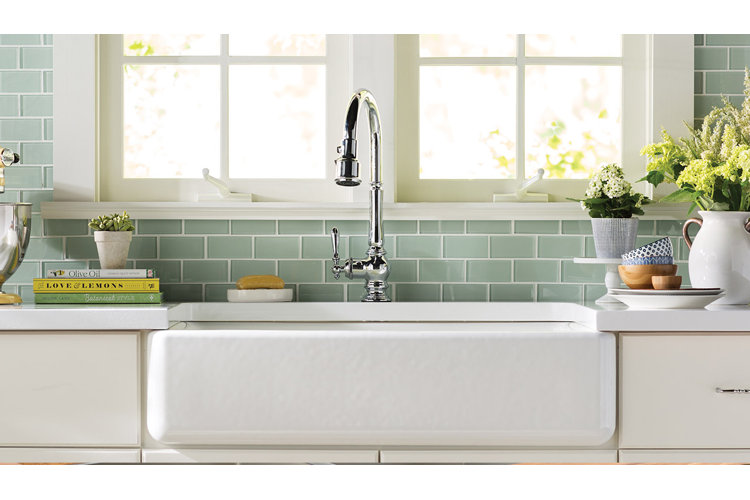
The right sink can make all the difference in your kitchen, so if there was ever a time to do your homework, this is it. To start, think about how you use your sink. Then, take a look at our breakdown of types and materials to find one that’s just right.
Kitchen Sink Types to Know
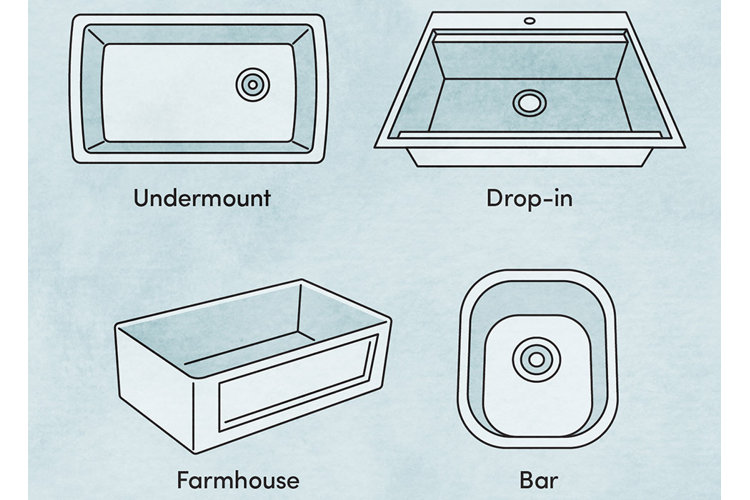
Undermount: Installed directly below the countertop, these sinks maximize space and result in an easy-to-clean counter. They’re best installed in surfaces made of thicker materials, like granite or marble.
Shop Undermount Kitchen Sinks >>
Drop-In: Also known as a top-mount sink, this easy-to-install style drops directly into an opening on your countertop with the sink rim resting securely on the surface.
Shop Drop-In Sinks >>
Farmhouse: Also known as an apron sink, this of-the-moment style features an exposed front and a deep basin, making it ideal for washing large cookware.
Shop Farmhouse Sinks >>
Bar: Smaller in size than most standard sinks, this petite single-bowl is typically installed in a wet bar or center island to assist with food preparation.
Shop Bar & Prep Sinks >>
Kitchen Sink Materials
Stainless Steel: A common sink material, stainless steel is popular for its heat- and stain-resistant qualities. Sinks are available in a brush or satin finish.
Shop Stainless Steel Sinks >>
Fireclay: Glazed and fired at extremely high temperatures to produce a heavy-duty ceramic, fireclay sinks are resistant to scratches, chips, and stains.
Shop Fireclay Sinks >>
Quartz Granite Composite: Available in a variety of styles, finishes, and colors, this durable material boasts antimicrobial properties and is highly resistant to stains.
Shop Quartz Granite Composite Sinks >>
Additional Features to Consider
Faucet Compatibility: Not all sinks come equipped with a faucet. If buying one separately or reusing a current spout, be sure to check your sink mounting setup, including the number of faucet holes. If your sink of choice has more holes than needed, deck plates can be used to disguise them.
Shop Kitchen Sink Faucets >>
Size: The overall size of your sink should not exceed the overall width of your new or existing cabinet. It is recommended to have a sink installed that’s 3-inches smaller in overall length compared to the cabinets overall width. This ensure a satisfactory installation with mounting hardware. Alternatively, under special circumstances and approval from fabricator, it is possible to custom fit a sink that is the same exact measurements as the overall cabinet width.